
Keratoconus Treatment
Minamiaoyama Eye Clinic offers several keratoconus treatments, including intracorneal ring segments (ICRS), riboflavin/UV treatment,and corneal transplant.
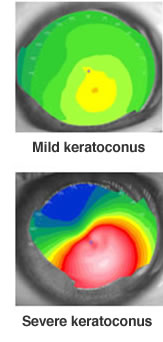
Keratoconus is a disease in which the cornea thins and bulges out. Patients with mild keratoconus have reduced and distorted vision. Hard contact lenses can correct up to moderate keratoconus, but does not work on severe keratoconus as they cannot provide adequate correction and may cause pain where the tip of the bulged out cornea rubs against the contact lens. Patients with severe keratoconus cannot wear contact lenses and require a corneal transplant. The pace of progression differs from one patient to the other, with the progression taking several months in some patients, but several years in others.
In the event you are diagnosed with keratoconus in the suitability exam, you unfortunately will not be able to undergo any vision corrective surgery by LASIK or PRK that uses an excimer laser because any corneal ablation to correct your vision may further reduce the strength of your corneas and hasten the progression of keratoconus.
Riboflavin/UV Treatment
The riboflavin/UV treatment, which suppresses the progression of keratoconus was developed by Seiler, et al. of Germany. Exposing the cornea to UV irradiation at 365 nm wavelength under ocular administration of riboflavin (vitamin B2) strengthens the collagen fibers in corneal stroma, allowing the suppression of the progression of keratoconus. In addition, nearsightedness may be alleviated due to a slight flattening of the corneal surface.
Intracorneal Rings Segments (ICRS)
Implanting a pair of semicircular intraocular ring segments into the cornea changes the corneal surface curvature, which corrects mild nearsightedness and delays the progression of keratoconus.
Intracorneal rings were originally developed for treating mild nearsightedness of up to approximately -3.00 D. However, due to their inability to treat astigmatism, ICRS have been used less often for correcting nearsightedness. Nevertheless, they have continued to be used to provide supplemental correction after LASIK procedures.
Since it became known that Intracorneal ring segments, which smooth out the bulge from keratoconus when implanted into keratoconic eyes can correct vision with eyeglasses and enable contact lens usage, they are now used to treat keratoconus. In the cornea, intracorneal ring segments work like a structural frame to strengthen the cornea, enabling the patient to avoid or delay corneal transplantation. Corneal contour, however, changes only gradually following an ICRS surgery as compared to the immediate results after a LASIK procedure.
ICRS are a very effective way to restore vision and delay the progression of keratoconus in progressive keratoconic patients. Patients whose vision can be restored by eyeglasses may undergo a phakic IOL implantation to restore their unaided vision. Minamiaoyama Eye Clinic began offering ICRS in 2000.
Surgery
In ICRS procedures, a small incision is made to the cornea following topical anesthesia to allow the creation from the incision site of two arch-shape tunnels where the pair of semicircular ring segments are to be inserted. The procedure is reversible by removing the ring segments after the surgery.
Corneal Transplant
Surgery
Under retrobulbar anesthesia, a form of topical anesthesia, a circular incision is made on the cornea using an instrument called trephine. Subsequently, the donor cornea is cut to almost the exact size as the circular area of the cornea that has been removed, and is sutured to the cornea with extremely fine sutures.